For residents of Purley, the dormant site of the former leisure centre and Sainsbury’s has been a visible reminder of stalled infrastructure. However, a significant regulatory hurdle has now been cleared, paving the way for physical transformation. Following a review by the Greater London Authority (GLA), Deputy Mayor for Planning Jules Pipe has confirmed that the Mayor’s office will not obstruct the redevelopment plans.
This decision is the critical “go” signal the project required. With the planning impasse resolved, the timeline for delivery has sharpened: construction on the comprehensive regeneration of the High Street site is now expected to commence in 2026.
The Procedural Roadmap
While the GLA decision eliminates the major strategic obstacle, a strict procedural path remains before spades hit the ground. Croydon Council must now formally issue the planning permission. Once granted, a statutory six-week judicial review period will commence. This legal window allows for the decision to be contested in court. Providing this period concludes without action the site, which has been inactive since the pool’s closure in 2020, will finally move to the construction phase.
Engineering the New Leisure Centre
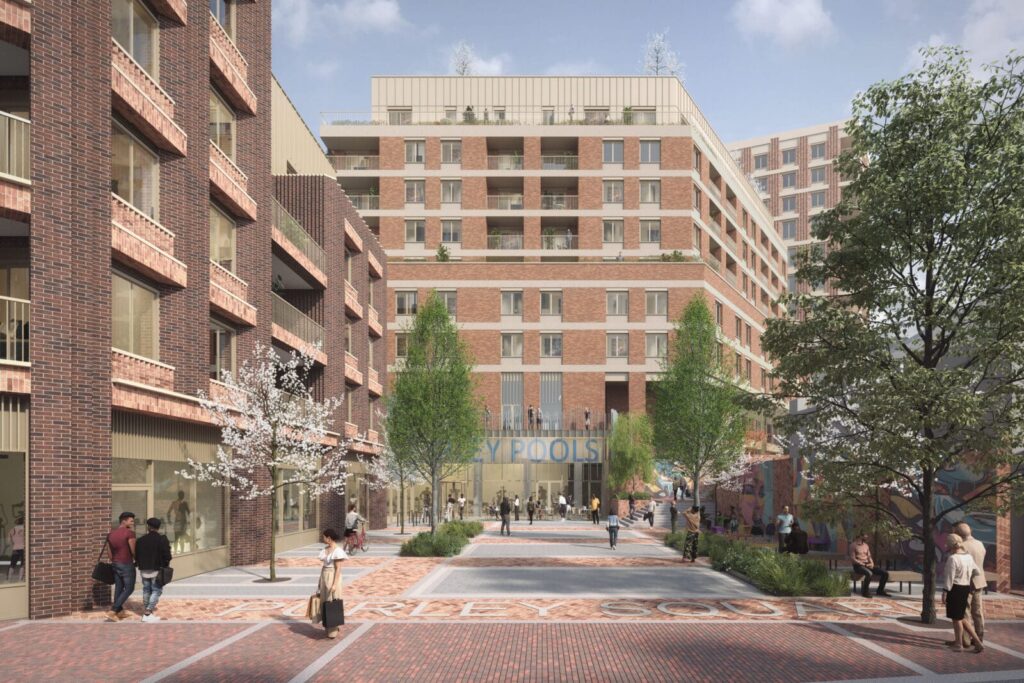
The redevelopment is being spearheaded by Polaska, the leaseholder for the site, but the operational output is a public asset. The specifications for the new leisure centre have been designed to correct the limitations of the old facility. The new complex will feature:
- A 25-metre, six-lane main pool alongside a dedicated training pool.
- An 80-station gym and fitness suite, which has been expanded in revised plans to meet modern capacity demands.
- A café designed with direct sightlines to a new soft play area, improving supervision for parents.
Critically, while Polaska constructs the facility, ownership and management will remain with the Council, operated by its contractor GLL, ensuring public control over programming and pricing.
Residential and Public Realm Integration
The viability of the project is underpinned by a mixed-use model. The site will host 220 later-living residences, addressing the borough’s need for specialist senior housing. In line with planning requirements, 10 per cent of these units will be designated as affordable housing.
Beyond the buildings, the masterplan aims to repair the urban fabric of the High Street. The design includes a new public square intended to function as a civic focal point for markets and local festivals, creating a pedestrian link that has been missing for years.
The Infrastructure of Access
One of the most contentious engineering challenges for this site has been parking. The existing multi-storey car park is set for demolition, a point of friction for local businesses concerned about accessibility.
While the GLA initially encouraged a “car-free” development, the finalized proposal acknowledges the practical realities of the district. The plans incorporate a new public car park with 78 bays, balancing the push for active travel with the necessity of vehicle access for leisure centre users and the elderly residents of the later-living scheme.
Moving Forward
Executive Mayor Jason Perry has described the GLA’s non-intervention as a “major step” toward fulfilling the promise to return a swimming pool to the district. After years of theoretical designs and planning debates, the project is now entering its delivery phase. Residents can expect the procedural formalities to conclude in the coming months, shifting the focus from planning committees to construction logistics as we approach the 2026 start date.